Wednesday, November 29, 2023

Old man, young man; which is which?

 The fact that I'm asking this question gives away the answer, but based on their pictures alone, who do you think looks older: Howie Koplitz or Art Fowler?


Fowler looks young and strong. Koplitz looks like he should be sitting in a rocking-chair on the porch, spitting tobacco out of his bird-thin lips. 

Art Fowler was 41 in 1964. Howie Koplitz was 24 in 1962. Not only was Koplitz younger, he was seventeen years younger. Koplitz's premature elderliness is honestly frightening.

Their careers were likewise dissimilar. 

Art Fowler was a late-bloomer. He was 31 years old when he debuted for the Cincinnati Reds in 1954, after an unspectacular minor league career in which he had won only 4 games above AA, but over the next three years he was a solid starter for the Reds. He was eerily consistent, winning 12, 11, and 11 games with ERAs of 3.83, 3.90, 4.05, though he did lead the NL in Fielding Independent Pitching in that third year with a mark of 3.09. But he had a 6.47 ERA in 1957, a 1958 spent in the PCL, and a 5.31 ERA in 1959. His career seemed to be over.

But after two solid years in the American Association in the Dodgers' system in 1960 and 1961, he made it back to the majors with the Angels in 1961 at the tender age of 38. He was excellent from 1961 to 1963, with ERAs of 3.64, 2.81, and 2.42, but after a 10.29 ERA in 4 games in 1964 he returned to the minors, this time for good. He continued to pitch well in the Pacific Coast League and in his last season, 1970, at 47, he had a 1.59 ERA and saved 15 games for the Denver Bears. For his career, he won 259 games and appeared in 1037. 

Howie Koplitz's career was out of pro ball when he was 28, three years younger than when Fowler reached the major leagues. His star season for the Birmingham Barons in the Southern Association in 1961 (23-3, 166 K's, 2.11 ERA) catapulted him to the majors, but once there he didn't do much. He did have a 2-0 record for the Tigers in 1961, which gave him a record for the year of 25-3, but for his major league career he only had a record of 9-7 with a 4.21 ERA. In 1964, he had a shocking record of 2-12 for Toronto and Tacoma in AAA, though his ERA was 2.92. 


Wednesday, November 22, 2023

Who's the little guy in the suit?

 I was idly looking through my 1964 Topps cards when I stumbled upon the 1964 Milwaukee Braves team card, and wondered, "Who's the small man in the black suit on the far left?" 

It turned out be a man named Don Davidson, who was the Braves' traveling secretary at the time.

Davidson suffered a bout of sleeping sickness when he was five which stunted his growth, and he grew to only 4'2". He began his life in baseball in 1939, as batboy for the Boston Braves, and joined the Braves office in 1948. He held various jobs with the Braves, among them public relations director and assistant to the president, until he was fired by Ted Turner in 1976. 🙄

He served with the Astros for a few more years, and died of cancer in 1990 at 64.


Davidson is supposed to have given Henry Aaron his nickname of "Hammering Hank." 

His autobiography was titled "Caught Short." 

As his obituary says, "Davidson received the New York Baseball Writer's Bill Slocum Award for long and meritorious service in 1971, was honored by the Houston chapter of the Baseball Writers Association of America in 1986, and received the Robert O. Fishel Award for baseball public relations excellence in 1989."

When the small suited gentleman on the far left of the Braves' team card caught my eye, I had no idea how much history was behind him. 

Speaking of history...

I wrote two other blog posts today for my two baseball history blogs. (This is my first time to turn the hat trick of writing posts on all three of my blogs.) One was about a player named George Ely, a one-armed left-handed second baseman who starred in Los Angeles semi-pro baseball for several years, and the other was about Bernard Hannegan, who may have thrown the first curveball.

https://semiprobaseballhistory.blogspot.com/2023/11/george-ely-one-armed-wonder.html
https://johnsbaseballblog.blogspot.com/2023/11/did-bernard-hannegan-throw-first-curve.html

Saturday, November 18, 2023

Coin on card: Cliff Johnson's Silver Half-Dollar

 Hi y'all. It's been a really long time since I last posted. I haven't stopped collecting, but my focus has been elsewhere. 

But lately I've been looking through my cards and finding things I want to talk about, so here I am, starting up this blog again after a year-long hiatus.

Looking through my stack of 1975 Minis this week, I noticed that Cliff Johnson wore a Benjamin Franklin silver half-dollar on a chain around his neck. This is the first time I've ever noticed money making an appearance on a baseball card.


     A slightly closer look:
                                                                                                                                                                                                   
And here's a Benjamin half-dollar for comparison:


That's really all I have for tonight.

I'll probably keep posting "stuff I noticed" posts like this, and I might also chronicle some of the cards I've acquired while my blog was sleeping.

Thanks for reading! 

Wednesday, September 21, 2022

A White Whale Speared: 1930 Zeenut Tub Perry

  To explain why I'd been searching for a 1930 Zeenut Clyde "Tub" Perry for years requires some explanation. I'm not related to him. I have no connections with him at all. His pro career was short and mediocre: a 7-7 record with a 6.02 ERA for the San Francisco Seals in 1930 and that's it. He didn't become a TV star after his career; nothing. 

The answer lies in an odd direction: semi-pro baseball. Up until about 1950, there wasn't much of a difference between the low minor leagues and semi-pro ball (town teams, or teams sponsored by businesses.) The quality of semi-pro ball ranged from completely amateur leagues to competitive leagues filled with major and minor leaguers. 

Though Tub Perry's pro career was short, he had a long and distinguished career as a pitcher/outfielder in one of my favorite semi-pro leagues, the Sacramento Valley League. It has a special place in my heart because it was the league that got me interested in semi-pro ball, but it was also a very good league, equivalent to a good D league at the time. 

His first year in the league was with Dunnigan in 1924, and he played in the league until 1950. It was a league filled with future or former Pacific Coast League players, but he absolutely dominated. 

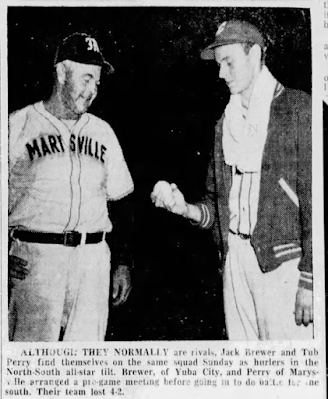
Tub Perry in 1950. (left, obviously)

In 1929, for instance, he was 16-2 with a 2.05 ERA, and hit .329. He hit over .400 five times, once hit as high as .454,  and what stats I've found or compiled show his lifetime record as 116-47 and his career average as .334. He spent a total of 22 seasons with the Marysville Giants. 

To summarize, he's my favorite semi-pro player and I'd been looking for his 1930 Zeenut card for a long time. The problem with that, as some of you know, is that finding any individual Zeenut card is almost impossible. 

I kept a lookout on eBay, on forums, on COMC, and at card shows, but never saw it. 

I found one in an odd way on Net54. There was a thread on the 1950s minor league Globe Printing sets, and I casually mentioned that I'd been wanting Clyde Brud Perry's card in the set as he was the son of Clyde "Tub" Perry. A member asked if I had Tub's Zeenut card. I didn't, but he did, and it was available for sale!


Its corners were lopped off, but overall Zeenuts don't get much better., The price was reasonable, and I bought it without qualms. And, to make my happiness untainted with practical matters, my grandpa paid for the card. 


Monday, May 30, 2022

O-Pee-Chee!

 Well, it's been over two months since I last posted. Woops. I haven't been thinking much about baseball cards for a while, partly because my budget was gone and partly because I was focusing on baseball research. But I'm back, and I figure I might as well pick up where I left off, showing the awesome cards I got from a Net54 member. If you don't remember the first installment, and I wouldn't blame you, here's the link for it: 

 https://adventuresofabaseballcardcollector.blogspot.com/2022/03/the-best-purchase-ive-ever-made.html

Sometimes my interest in cards dims after a few months, but I'm still excited about these. As the title of this post suggests, I'll be showing the OPC portion of the purchase, about 40 cards from 1969 to 1972. 
These were my first 1969 OPC cards. 
I love the circle around the card number. 
There was a decent amount of 1970s, but nothing too exciting. Well, the Dick Hall and Didier cards are great. 
Overall, this may be the only OPC set from 1969 onward with a back that's worse than the Topps back, but it is the first OPC set with French on the back, which counts for something. 
I love 1971 O-Pee-Chee. 1971 Topps is awesome enough with dull backs, and the yellow backs with spectral floating heads really takes the set to the next level. 


But the highlight of the 1971s, and all the OPC cards, was the one without French on the back. As you may know, cards 524 to 752 had the same backs as Topps except in yellow, and are freakishly rare. Completing the full 752 card set is almost impossible. Somehow, in this extremely cheap lot of cards there was a 1971 OPC high number.


I was shocked, to say the least. The guy who I got it from was selling me his duplicates, which means he had two copies of this card, which is pretty impressive. 

Nothing else was quite that exciting, but 1972 OPC is nice too. 


And the backs are some of the brightest O-Pee-Chee ever produced.

To cap this post off, here's a Topps Venezuelan from the same purchase.

1966 Topps Venezuelan is odd because there's nothing to indicate it's not Topps except the unusual feel and look of the card. It's hard to explain, but they're completely different in person.

Anyhow, that's it for today, but there are still a lot of awesome cards from that purchase to post. 

Wednesday, March 23, 2022

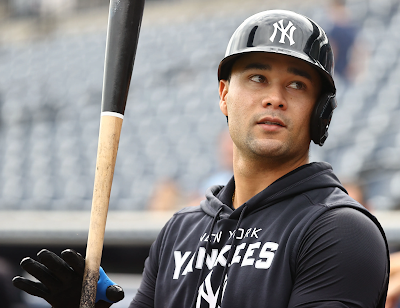
Isiah Kiner-Falefa is a Yankee!

 Those were a weird few days. First I see that Isiah Kiner-Falefa was traded to the Twins, and I'm disappointed. I'd seen rumors of him going to the Yankees, and I was really hoping for that. I care less about the Twins than the Rangers, which is saying a lot. 

And next thing I know he's traded to the Yankees. Yes!

He looks weird without a beard.

For those who don't know why I'm so excited, I'm a big fan of Isiah because I watched him play with the Frisco Rough Riders in 2016 and 2017. As I said in a post earlier last year: 

"It seemed like every time I went to see the Rough Riders, Isiah would be playing. He was a constant, an oasis in an ever-changing roster. I have very fond memories of the P.A saying " Isiah Kiiineerrr FALEFAAAAAA!!!!!!" "

He's not a great player, but he's good. He's a very good fielder at shortstop and third base, and he's adequate at catcher. (He might be the Yankees' best option at catcher, actually.) Not much at the plate, but he's fine. 

I think that it was a good trade. I'm so glad to see Gary Sanchez go. He was a constant frustration. I'll miss Gio Urshela. He was good, and it was also nice to have someone named Giovanny. 

But it'll be good having Josh Donaldson at third, as long as he stays healthy, and I'm obviously glad to get Isiah Kiner-Falefa. 

Can't wait to get my first Yankees card of him. 


Friday, March 11, 2022

The best purchase I've ever made

 A few weeks ago I made the biggest purchase of my life. But I should back up a little.

Remember the cards I got for Christmas? The huge lot of low-mid grade cards from 1948 to 1959? They were from the same guy. I wrote him saying that I really enjoyed the cards... and did he have any more like them available?

Well, he did. He's a set collector with a lot of duplicates, and they were all available. In the end, I got over 700 cards from 1939 to 1973 for $176. I completely blew out my baseball card budget (and I may have dipped a bit into savings), but it was worth every penny and more.

I'll be spreading this out over several posts, because there's a lot that's worth showing. 

The cards were split into several groups, and the largest was the group of 1960s Topps cards -461 cards for $100, or about 22 cents per card. 


So beautiful...

There wasn't a ton from 1960, but this was my favorite. I like the 1960 manager cards, and it's cool to have the manager of the 1960 Pirates. I also like how he's wearing a helmet.


I like the cartoon too.

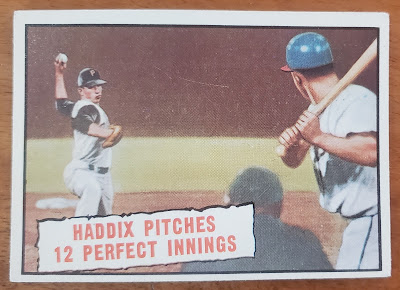
Here are four sluggers from 1961 Topps. (Klu!)There was a pretty good amount of 1961 Topps, a set I like. Yeah, the design's pretty boring and there are a lot of hatless pictures, but when the picture's nice they're beautiful.

Rocky Nelson didn't do much in the majors, but had some great seasons with north-of-the-border minor league teams. From 1953 to 1955, with the Montreal Royals, he had triple crown stats of .308/34/136, .311/31/94, and .364/37/130. In that last season he had more homers than strikeouts (36). He started 1956 hitting .394 with 12 homers, getting a call to the Dodgers. He hit .208, and was traded to the Cardinals. 1957 and 1958 he played with the Toronto Maple Leafs, hitting .294/28/102 in 1957 and .326/43/120 in 1958. He went to the majors in 1959, and two of his three seasons with the Pirates were very good. 


My first card of Pumpsie Green.

Always great to get cards of Mudcat Grant and Don Mossi.
I think this card is gorgeous.

I always love getting cards featured in the Great American Baseball Card book. 
These are two high numbers. I have a disproportionate amount of 1963 high and semi-high number cards. 
And here's some more cards from the Great American Baseball Card book. 
Colt. 45s, 5'5'' Albie Pearson, and the rookie card of the famous Angel Billy Cowan, seen here without his halo. 
Jim Umbricht's last card is the more subtle counterpart of Ken Hubbs'. 
I like these. A little pencil (or pen) transformed Hal Smith into Hal McRae, Woody Held into Merv Rettenmund, and Jim Duffalo into Dick Dietz. 
1966 Topps was the set with the most representation -126. Most of them are in very nice condition, too.

It's ironic how Smoky Burgess's card was trimmed thin. 

Yankees!
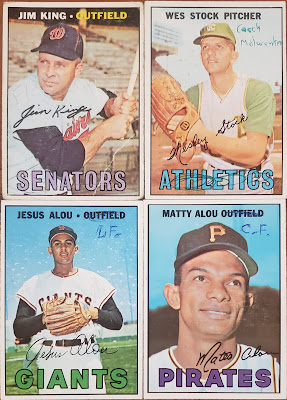
Wes Stock was coach for the Milwaukee Brewers in 1972, so that means his card was modified in 1972. Interesting. 
Dick Allen, the floating, disembodied head of Mickey Mantle, and two Mets. I love 1967 Topps  ( I say every time.) 
These are high numbers.
I love Vic Davalillo, but he looks like a gremlin on this card.
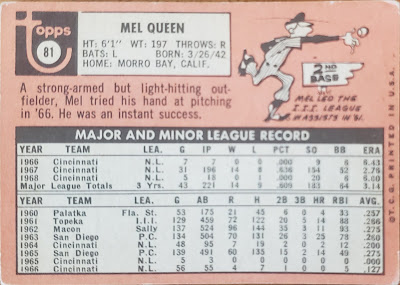
I was glad to finally get the semi-famous 1969 Mel Queen. 

As you can tell, I got some great cards for a great price. This is just the beginning. 

Thanks G1911 for the cards, and thanks everyone for reading!